Have you ever paused to wonder about the deeper meaning behind the name Lily? Many parents choose this name simply for its elegance. But the lily name meaning in the Bible goes far beyond a pretty flower.
It carries a rich spiritual message woven throughout Scripture from the Song of Solomon to the Sermon on the Mount.
The lily name meaning in the Bible points to purity, divine care, and renewed hope. It is a name rooted not just in nature, but in faith.
If you have been searching for what this name truly represents in a Christian context, this article is your complete guide to the lily name meaning in the Bible.
When people research the lily name meaning in the Bible, they often discover something unexpected: this single flower touches some of the most tender and powerful teachings in all of God’s word.
The lily name meaning in the Bible connects believers to themes of trust, rest, beauty, and unwavering divine love. Let’s explore every dimension of what the lily means spiritually, historically, and personally.
Biblical Meaning of the Lily in the Bible
The lily name meaning in the Bible begins with the biblical meaning of lily flower, which traces back to the Hebrew word shushan or shoshan, meaning “whiteness.” This word was used across ancient Syrian and Hebrew culture to describe several beautiful, lily-like flowers including the iris, anemone, tulip, and water-lily.
The lily appears in Scripture more than thirteen times and carries layered symbolic weight in nearly every mention.
In the Song of Solomon, the lily is used as a metaphor for love, beauty, and spiritual devotion. In the Psalms, the titles of certain songs reference lilies, pointing to their deep cultural and religious significance.
In the New Testament, Jesus himself uses the lily as the centerpiece of one of his most powerful teachings on faith and God’s provision.
Understanding the lily name meaning in the Bible means understanding what God communicates through nature and the lily speaks with remarkable clarity and depth. Every time this flower is mentioned in Scripture, it is pointing toward something larger: a God who is attentive, generous, and intimately involved in His creation.
Lily as a Symbol of Purity
The Christian symbolism of white lily is one of the most recognised in all of religious art and theology. The pristine white petals of the lily have long been associated with purity, innocence, and moral wholeness before God.
In biblical artwork throughout history, the lily is placed beside the Virgin Mary to represent her role as a pure vessel chosen by God. This association reflects the biblical conviction that purity and innocence in the Bible are among the most honoured qualities a person can carry.
For someone named Lily, this is a beautiful reminder: the lily name meaning in the Bible calls you toward a life of inner purity and holiness not through perfection, but through surrender to God’s transforming grace.
Lily and God’s Provision
One of the most comforting threads in the lily name meaning in the Bible is what it reveals about God’s provision. When Jesus pointed to the lilies growing in the open fields, he was not giving a botany lesson. He was making a theological statement: if God clothes even the most fleeting wildflower in breathtaking beauty, how much more will He provide for those He loves?
This is the heart of God’s provision and care scripture. The lily becomes a living proof that God is attentive, generous, and deeply personal. Bearing the name Lily carries this promise a daily reminder of God’s loving care and His unwavering faithfulness toward you.
Lily as Beauty Without Pride
One of the overlooked dimensions of lily symbolism is humility. The lily blooms without effort, without pride, and without striving for recognition. It simply is what God made it to be and that is enough.
This connects powerfully to the theme of humility and beauty in Christianity. True beauty, according to the Bible, is not found in outward adornment or human glory. It is found in a life aligned with God’s design.
The lily, which outshines even Solomon’s royal robes while remaining rooted in a simple field, is the perfect picture of this truth.
The lily name meaning in the Bible therefore carries a quiet but firm message about where real beauty comes from not from human striving, but from God’s creative hand shaping a willing heart.
Positive Meaning of the Lily Name
The lily name meaning in the Bible carries overwhelmingly positive spiritual connotations. It speaks of a life valued and covered by God’s care. It speaks of inner beauty that reflects divine grace. It points to a spirit of peace that rests in God’s promises and renewed strength that rises after difficult seasons.
Whether given as a name at birth or encountered in Scripture, the lily communicates that God’s goodness is present, near, and abundantly real in every season of life.
Spiritual Significance and Symbolism
The lily name meaning in the Bible and its spiritual meaning of lily flower extend beyond physical beauty. In Christianity, the lily is regarded as one of the most meaningful flowers precisely because it bridges the natural and the divine. It is not merely decorative it is instructive.
The lily name meaning in the Bible sits at the intersection of God’s creation and His character. Understanding this helps believers see the natural world not as separate from their faith, but as a continuous classroom where God is always teaching.
Lily as Spiritual Rest
The lily grows without toiling or striving. It does not work to be beautiful it simply receives what God provides. This is perhaps the most quietly profound aspect of the lily spiritual significance Bible offers to readers.
For believers, this is a powerful invitation to spiritual rest. So much of modern life is defined by anxiety, performance, and self-reliance. The lily says something entirely different: rest in God, and let His provision clothe you.
This is the kind of peace and trust in God that transforms daily life. It is not passive it is a deeply active surrender that requires genuine faith. And this is exactly the spirit the lily name meaning in the Bible represents.
Symbol of Renewal and Hope
Lilies bloom after winter. They emerge from cold, dark soil into warmth and light year after year without fail. This cyclical pattern makes the lily a powerful symbol of renewal and hope that Bible readers have cherished for centuries.
Just as Christ’s resurrection reversed the finality of death, the lily’s annual return mirrors that same message: spiritual healing and hope are always available, no matter the season you have walked through.
The lily name meaning in the Bible is, at its core, a message of renewal after hardship. This is why the lily name meaning in the Bible resonates so deeply with believers who have walked through loss, grief, or spiritual dryness.
Personal Faith Connection
Many believers who carry the name Lily or who love someone who does find a deep personal connection in what the flower represents spiritually. God’s word tells us in Hosea 14:5 that Israel “shall blossom as the lily,” tying the flower directly to spiritual restoration and God’s renewed favour.
For the individual believer, this personal dimension of the lily name meaning in the Bible is deeply encouraging. God is restoring, beautifying, and faithfully working even in seasons when the ground feels cold and silent.
Biblical Interpretations in Dreams or Real Life
The lily name meaning in the Bible tradition around dream interpretation is an ancient and respected one. Throughout Scripture, God used natural imagery including flowers to communicate spiritual messages. When a lily appears meaningfully in a dream or stands out in daily life, it is worth reflecting on what God may be communicating.
The lily name meaning in the Bible can inform how we interpret these encounters, giving us a biblical framework for understanding what the Spirit may be saying.
Peaceful or Bright Lilies
Seeing bright, full, and beautiful lilies in a dream or vision is generally interpreted as a sign of divine protection and guidance a message of peace, purity, and divine favour. It may be a reassurance that God is present, providing, or that a season of spiritual beauty and blessing is near.
In these moments, the lily name meaning in the Bible speaks most clearly: you are known by God, and He is tenderly taking care of you. This is the reassurance that the lily name meaning in the Bible was always meant to communicate a God who sees and provides.
Wilted or Hidden Lilies
On the other hand, wilted, hidden, or dying lilies in dreams may carry a different kind of spiritual message. Rather than a sign of doom, they often represent a gentle call to return to reconnect with God’s word, to seek renewal, or to address an area where faith has grown cold.
Even a wilted lily can bloom again. There is always hope and always restoration available in God. Prayer and honest reflection are the appropriate response to such gentle prompts from the Holy Spirit.
Lily in the Teachings of Jesus (Lilies of the Field – Matthew 6:28–30)
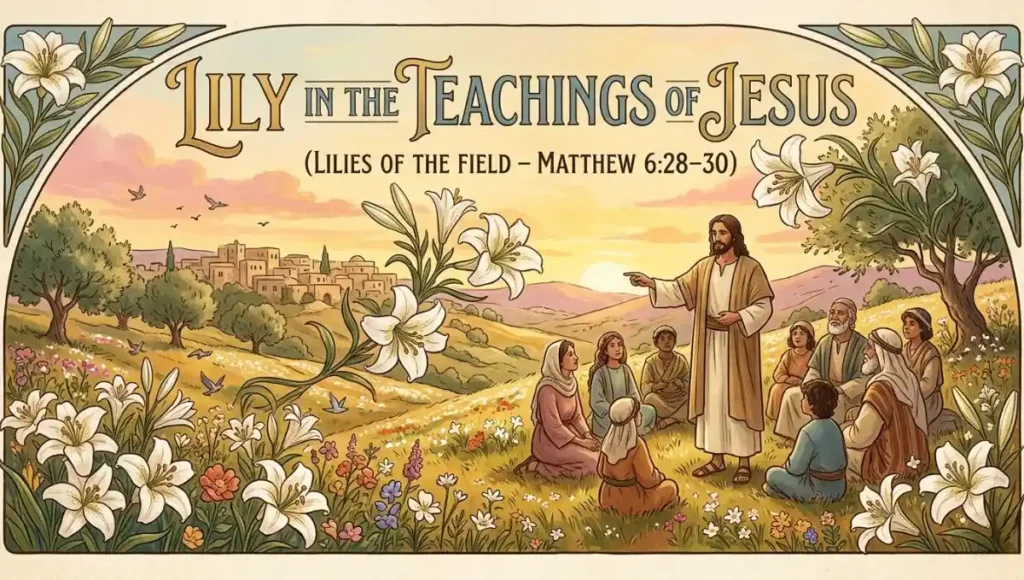
No discussion of the lily name meaning in the Bible would be complete without spending time in one of Jesus’s most beloved passages. The lily name meaning in the Bible reaches its highest New Testament expression in Matthew 6:28–30, during his famous Sermon on the Mount, where Jesus says:
“Consider the lilies of the field, how they grow; they toil not, neither do they spin: And yet I say unto you, That even Solomon in all his glory was not arrayed like one of these. Wherefore, if God so clothe the grass of the field, which today is, and tomorrow is cast into the oven, shall he not much more clothe you, O ye of little faith?”
The Jesus lilies of the field meaning here is layered and rich. Jesus was speaking to people gripped by anxiety about food, clothing, and daily provision.
His answer was not a practical plan it was a theological one. He pointed them to the fields and said: look at what God does for something as fleeting as a wildflower.
The Matthew 6:28–30 explanation carries several important spiritual truths. First, worry is a form of misplaced trust. Second, God’s provision is not limited to the powerful or the wealthy it reaches even the smallest flower in the most ordinary field.
Third, the beauty God lavishes on creation is evidence of His extravagant generosity toward all He has made.
The lily name meaning in the Bible finds its clearest New Testament expression right here. The biblical meaning of lilies of the field explained simply: God sees you, God values you, and God will provide far beyond what you could arrange for yourself.
The faith over fear message could not be clearer. Jesus was not calling his followers to passivity he was calling them to a higher kind of activity: seeking first the Kingdom of God, with full confidence that everything else would follow (Matthew 6:33). This is the faith and trust in God teachings that remain just as relevant today.
Read Also: Damian Meaning in the Bible: A Spiritual and Christian Insight
Historical Context of Lilies in Ancient Israel and the Middle East
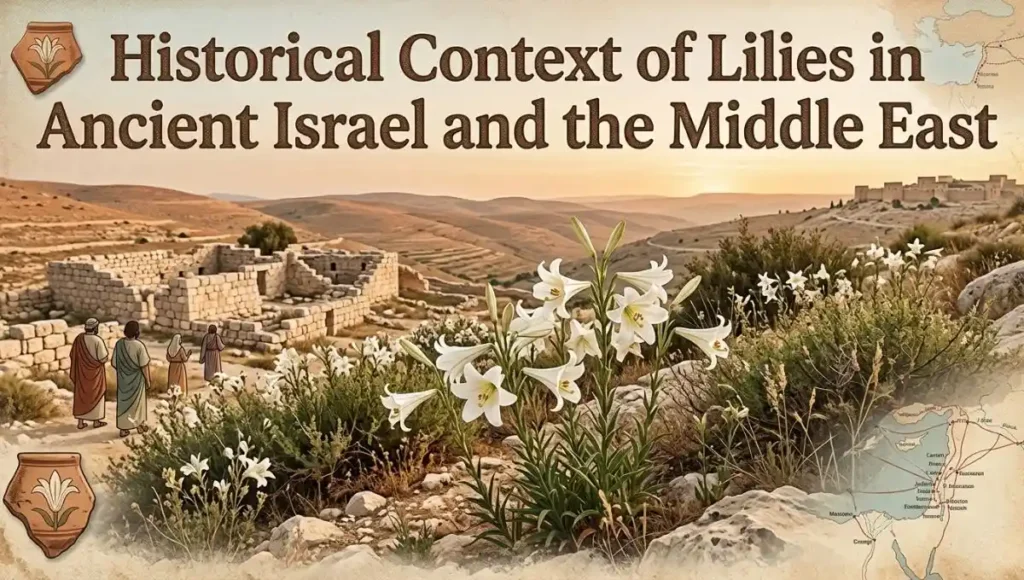
To fully appreciate the lily name meaning in the Bible, it helps to understand the world in which these texts were written. Lilies were not rare or exotic in ancient Israel they were part of the everyday landscape and deeply embedded in the cultural imagination of the Hebrew people.
The lily name meaning in the Bible gains even deeper resonance when we see it through the eyes of those who walked among these flowers daily.
The Hebrew word shushan (or shoshan) meant “whiteness” and was applied broadly to several lily-like flowers common to Syria and the Levant, including the iris, anemone, ranunculus, and gladiolus. The Lilium candidum a white lily still known today grew wild in the Lebanon region and in the northern parts of Palestine.
According to ancient sources and Bible dictionaries, lilies were so plentiful during the time of Solomon that they were used as architectural models. The decorative capitals of the great Temple pillars in Jerusalem and the molten sea were carved in the shape of lily blossoms (1 Kings 7:19, 22, 26).
This means the lily was not only a field flower it was elevated to sacred architectural significance in the very house of God.
In the Song of Solomon, lilies appear eight times as shoshan, representing beauty, love, and spiritual intimacy.
The phrase “lily of the valleys” in Song of Solomon 2:1 referred to the rich, deep-soiled lowland areas where these beautiful flowers thrived in abundance a fitting image for spiritual fruitfulness.
By the time Jesus taught on the lilies of the field, the flower was deeply woven into the spiritual and aesthetic consciousness of his Jewish audience.
When he pointed to a lily, everyone listening understood its associations: purity, beauty, fragrance, and divine creation. The lily name meaning in the Bible was already alive in their hearts Jesus simply drew it into the light.
The biblical flower meanings and symbols of the lily, therefore, are not invented by later Christians. They are rooted in a long tradition of Hebrew understanding of God’s beauty expressed in the natural world. This historical depth only adds to the richness of the lily name meaning in the Bible.
Key Bible Verses and References About Lilies Across Scripture

The lily in the Bible verse meaning shows up across both Testaments with consistent spiritual significance. Here is a summary of the key passages that define the full scope of lily symbolism in the Bible and reinforce the lily name meaning in the Bible at every level of Scripture:
Song of Solomon 2:1–2 — The lily represents spiritual beauty and the preciousness of devoted love, used to describe both the beloved and the nature of faithful relationship with God.
Song of Solomon 5:13 — The lily symbolises the fragrance and sweetness of holy relationship, with the lover’s lips compared to lilies dropping sweet myrrh.
Song of Solomon 6:2–3 — A picture of divine intimacy, rest, and spiritual refreshment, as the beloved is found among the lilies of the garden.
1 Kings 7:19, 22, 26 — The lily-shaped capitals and carvings in Solomon’s Temple reflect God’s creation and nature symbolism embedded into the very architecture of sacred worship.
Hosea 14:5 — God uses the lily to describe the spiritual flourishing and restoration He promises: “I will be as the dew unto Israel: he shall grow as the lily.” This is one of the most direct connections between the lily name meaning in the Bible and God’s promise of renewal.
Matthew 6:28–30 — The most well-known lily passage in the New Testament, where Jesus teaches about divine beauty and grace and freedom from the anxiety that comes from trusting self over God.
Luke 12:27 — A parallel passage reinforcing that the lily spiritual significance Bible carries is a core part of Jesus’s own teaching ministry throughout the Gospels.
Together, these verses paint a consistent, God-breathed picture of what the lily means and why the lily name meaning in the Bible carries such lasting spiritual power for every generation of believers.
Practical Lessons & Faith Insights
Understanding the lily name meaning in the Bible is not just an intellectual exercise it is meant to transform how we live.
Once you grasp what the lily name meaning in the Bible truly conveys, it becomes a living lens through which to view your daily walk with God. The lily carries practical spiritual lessons for every believer, regardless of whether they carry that name.
Stop striving, start trusting. The lily does not labour for its beauty. A life of faith is not about earning God’s love through endless effort.
It is about receiving it with open hands just as the lily name meaning in the Bible teaches resting in His provision as the lily rests in the soil and sunlight God provides.
Beauty is a by-product of surrender. The lily is stunning precisely because it grows in complete alignment with how God designed it. When we live according to God’s design in purity, humility, and faith our lives carry a beauty that no human effort can manufacture.
This is one of the most personal dimensions of what the lily name meaning in the Bible reveals.
God sees the small and the overlooked. The lilies of the field were not in a royal garden. They were in open country, seen by no one powerful and yet God dressed them in glory.
The lily name meaning in the Bible is biblical encouragement and peace for anyone who has ever felt invisible: God sees you and is already at work on your behalf.
Renewal is always coming. Lilies return after winter. Whatever season of difficulty, loss, or spiritual dryness you are in, the lily name meaning in the Bible whispers a promise: this is not the end. God brings spring after every winter, always and without fail.
Your name is a calling. For those named Lily, the lily name meaning in the Bible is not merely background information. It is a daily invitation to reflect God’s purity, to trust His care, to live with grace and without fear. Few names carry such a rich and tender calling as this one.
Conclusion
The lily name meaning in the Bible is far richer than a simple floral reference. From the Hebrew shushan to Jesus’s teaching in the fields of Galilee, the lily has consistently represented some of the most beautiful truths in all of Scripture purity, divine provision, humility, renewal, and the breathtaking generosity of God.
Whether you carry this name, are considering it for a child, or simply encountered the lily name meaning in the Bible while reading God’s word, the message is the same: God has clothed the lilies of the field in a glory that surpasses the greatest human splendour.
And if He does that for a flower that lasts a single season, He will do infinitely more for you.
The lily name meaning in the Bible is ultimately a message of love. God’s love attentive, generous, and ever-present. Let it encourage you, ground you, and fill you with the kind of faith that rests, trusts, and blooms just like the lily. When you truly understand the lily name meaning in the Bible, you understand something precious about the heart of God Himself.
FAQs
What is the lily name meaning in the Bible?
The lily name meaning in the Bible refers to purity, divine beauty, and God’s faithful care for His creation, rooted in the Hebrew word shushan meaning “whiteness,” and made famous by Jesus’s teaching in Matthew 6:28–30. The lily name meaning in the Bible is one of the richest floral meanings in all of Scripture.
Is Lily a biblical name?
Lily itself does not appear as a personal name in Scripture, but the Hebrew name Shoshana meaning lily appears in the Book of Daniel, making the lily name meaning in the Bible and its Hebrew roots deeply connected to authentic Scripture.
What does the lily represent in Christianity?
In Christianity, the lily symbolises purity, innocence, resurrection, and God’s generous provision, most powerfully illustrated by Jesus in Matthew 6:28–30. The lily name meaning in the Bible is central to how Christianity understands divine beauty and grace.
What did Jesus say about the lilies of the field?
Jesus said in Matthew 6:28–29 that not even Solomon in all his glory was dressed as beautifully as the lilies of the field, using them to teach that God’s provision infinitely exceeds what human striving or worry can secure. This teaching is the heart of the lily name meaning in the Bible in the New Testament.
What is the spiritual meaning of lily flower?
The spiritual meaning of lily flower encompasses rest in God’s provision, renewal after hardship, purity of heart, and the divine beauty that comes from living in surrender to God’s design all themes central to the lily name meaning in the Bible.
What does the lily mean in the Song of Solomon?
In the Song of Solomon, the lily represents spiritual beauty, love, fragrance of devotion, and the preciousness of the relationship between God and His people appearing eight times as shoshan. This is one of the oldest expressions of the lily name meaning in the Bible.
Does the lily symbolise resurrection in the Bible?
While not stated explicitly, the lily’s annual bloom after winter, its purity, and its association with new life have led many Christian traditions to connect it with resurrection hope and the renewal God brings after loss.
What does the name Lily mean spiritually?
Spiritually, the name Lily is associated with purity, grace, inner beauty, and a life of trust in God a name that carries a quiet but powerful calling rooted in the lily name meaning in the Bible.
What is the Hebrew word for lily in the Bible?
The Hebrew word for lily in the Bible is shushan or shoshan, meaning “whiteness,” and it appears thirteen times across the Old Testament, especially in the Song of Solomon and in Hosea 14:5.
Why did Jesus use lilies as an example in his teaching?
Jesus used lilies because they were a familiar, beautiful, and universally understood symbol in Jewish culture and because their effortless, God-clothed beauty perfectly illustrated the lily name meaning in the Bible: trusting God fully over anxious self-provision.

Zohaib Israr is a content writer at [prayersmsg.com], specializing in Messages and Prayers. With 5 years of experience, he creates meaningful, engaging, and easy-to-read content that connects with readers.








1 thought on “Lily Name Meaning in the Bible: A Symbol of Purity, Beauty, and God’s Care”