
Every year, thousands of people search for the Adonis meaning in Bible, curious about whether this famous name holds any scriptural significance.
The name Adonis is widely used in modern culture to describe ideal physical beauty. But does the Bible actually recognize it? Where does it come from? And what spiritual lessons can Christians draw from it?
This article dives deep into the Adonis meaning in Bible, exploring its ancient roots, mythological connections, linguistic links to Hebrew, and the powerful contrast it creates with biblical truth.
Whether you are a student of theology, a curious believer, or someone choosing a meaningful name, this guide offers a comprehensive and spiritually grounded perspective.
Detailed Explanation of Adonis Meaning in the Bible
The Adonis meaning in Bible is not defined through a direct biblical character. Instead, it emerges through historical, linguistic, and theological layers that connect Greek mythology to the ancient Near Eastern world the Bible describes.
At its core, the Adonis biblical meaning points to a pagan figure associated with beauty, desire, vegetation, and seasonal death and rebirth. Adonis was recognized as a god of vegetation and fertility, with a Syrian name meaning “lord,” and was worshipped in both Greece and Syria.
The Bible does not endorse this figure but it does warn against exactly the kind of worship Adonis represented. Unpacking the Adonis meaning in Bible requires engaging with both Scripture and ancient history simultaneously.
Understanding the Adonis meaning in Bible requires reading Scripture against the backdrop of the pagan world that surrounded ancient Israel.
The prophets consistently warned God’s people not to adopt the religious practices of neighboring nations practices that included the worship of gods like Adonis.
Is Adonis Mentioned in the Bible?
This is one of the most common questions when exploring the Adonis meaning in Bible. The answer is nuanced.
The name Adonis appears in the English Revised Version as a marginal note at Isaiah 17:10, where “pleasant plants” is rendered as “plantings of Adonis.” Most mainstream translations, however, use the phrase “pleasant plants” or “delightful plants” instead.
The Vulgate Bible in Ezekiel 8:14 uses the name Adonis as a rendering for Tammuz, a Syrian deity for whom Hebrew women held an annual lamentation. This idol was likely the same as the Phoenician Adon or Adonis.
So while the name Adonis is not embedded in the main text of most Bible translations, its equivalent Tammuz clearly appears in Scripture as a forbidden pagan deity. The Adonis meaning in Bible, therefore, is deeply tied to idol worship and false religion.
Scholars consistently note that exploring the Adonis meaning in Bible leads directly to these uncomfortable but important passages about pagan influence on ancient Israel.
Origin and Historical Background of Adonis
To fully grasp the Adonis meaning in Bible, we must travel back in time to the ancient Near East, the same world that forms the setting of the Old Testament.
Adonis appears to have been a kind of incarnation of the sun, regarded principally as connected to the apparent changes in its celestial position and the seasonal transformations of vegetation.
Worship of Adonis consisted of two parts: a season of mourning his disappearance, followed by celebrations of his discovery and return.
This cycle of mourning and rejoicing was practiced by the Syrians, Phoenicians, and Cyprians. These nations surrounded Israel geographically and spiritually challenged the faith of God’s people throughout the Old Testament period.
Meaning and Etymology
The name Adonis likely derives from a Phoenician form of the Hebrew word adon, meaning “lord.” The root word “Adon” (lord) reminds believers of the importance of recognizing God as the true Lord.
The Hebrew term related to Adonis appears only once in the Bible and is connected to the personal name Naaman and to the Hebrew word meaning “lovely, pleasant, or agreeable.”
This etymological trail is essential for understanding the Adonis meaning in Bible in its full depth. The name shares linguistic DNA with sacred Hebrew titles yet it was applied to a pagan deity who stood in opposition to the God of Israel.
Adonis in Ancient Mythology and Its Influence on Biblical Interpretation
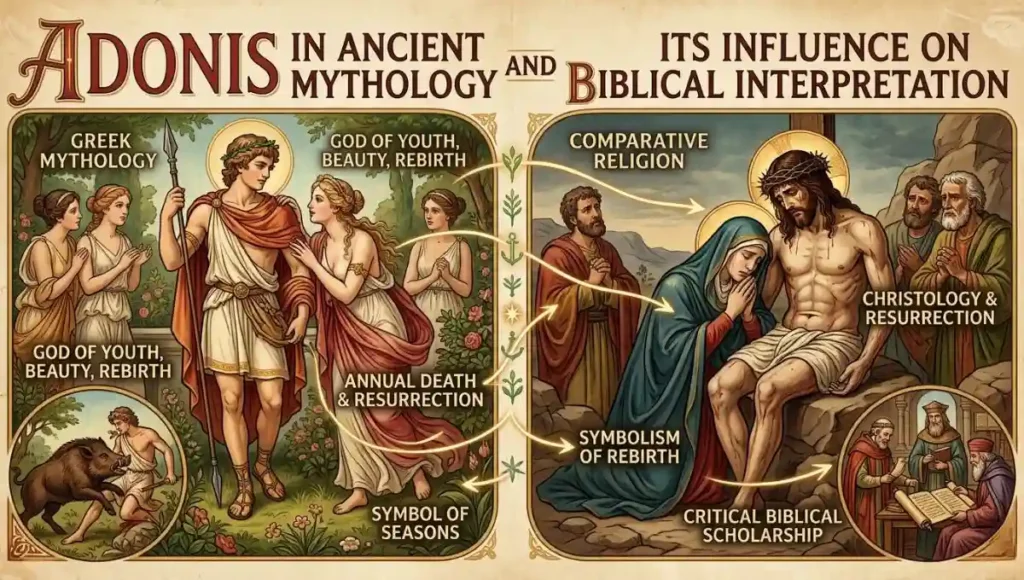
Greek mythology presents Adonis as a strikingly beautiful young man, beloved by the goddess Aphrodite (Venus). His beauty made him a favorite with Venus, and after his death from a wound inflicted by a wild boar, he was permitted to spend a portion of each year with her.
This death-and-resurrection cycle is critical to understanding why the Adonis meaning in Bible carries such theological weight. In the festival of Adonis, worshippers represented him as lying dead in a coffin, mourned him, and then celebrated his return and revival with expressions of great joy along with practices the Bible would classify as immoral.
These resurrection myths were widespread across ancient Near Eastern religions. They offered a counterfeit version of the hope for new life a hope that the Bible places exclusively in the God of Israel and, for Christians, in Jesus Christ.
The Adonis biblical perspective sharpens when we realize that the resurrection narrative the Bible presents is radically different: it is historical, personal, and rooted in the one true God. This is why the Adonis meaning in Bible is more than a curiosity it is a theological boundary marker.
Adonis vs Adonai: A Critical Biblical Comparison
Perhaps no comparison clarifies the Adonis meaning in Bible more powerfully than placing it side by side with Adonai.
Adonai is one of the primary names for God in Hebrew Scripture, formally a plural form meaning “Lords,” but constructed as a respectful singular. The singular form, Adoni (meaning “lord”), was used by the Phoenicians for the pagan god Tammuz and this is the origin of the Greek name Adonis.
In the Hebrew Bible, adoni with the first-person possessive suffix means “my lord” and is a term of respect that may refer to God or a human superior, whereas Adonai literally “my Lords” is reserved exclusively for God.
The difference is spiritually profound. Adonai is holy, set apart, and used only in reference to the Creator of the universe. Adonis borrowed the same linguistic root and applied it to a mortal, mythological figure of beauty and desire.
The Adonis meaning in Bible thus serves as a cautionary contrast: the same concept of “lordship” can either honor the living God or be redirected toward idols.
“I am the LORD; that is my name! I will not yield my glory to another or my praise to idols.” Isaiah 42:8
Symbolism of Adonis in a Biblical Context
When examining the Adonis meaning in Bible symbolically, several themes emerge that Scripture addresses directly. Each theme deepens our understanding of why the Adonis meaning in Bible remains relevant for Christian theology today.
Physical Beauty vs. Inner Character. Adonis represents the pinnacle of outward appearance. The Bible consistently redirects this focus inward. “Man looks at the outward appearance, but the LORD looks at the heart.” (1 Samuel 16:7)
Temporary vs. Eternal. The Adonis myth centers on seasonal death and rebirth a cycle that ends. Biblical truth offers eternal life, not a repeating natural cycle.
Idolatry vs. True Worship. The Hebrew prophet Ezekiel recorded God showing him women weeping for Adonis (Tammuz) even within the temple in Jerusalem a scene of profound spiritual betrayal. The Adonis symbolism in Christianity, therefore, stands as a warning against allowing cultural idols to enter the sacred space of the heart.
Desire vs. Holiness. Adonis mythology is deeply intertwined with sensual desire and the worship of Aphrodite. The Bible calls believers to set their minds on things above (Colossians 3:2), not on earthly passions.
Cultural Context: Why Adonis Was Popular
Understanding why Adonis was so widely worshipped helps us appreciate why the Adonis meaning in Bible carries such a strong warning for believers today. The cultural forces that made Adonis attractive in the ancient world are not so different from what shapes modern culture and studying the Adonis meaning in Bible makes that connection unmistakably clear.
The festival of Adonis was originally celebrated by the Syrians and then spread to all the nations around the Mediterranean. It resonated because it mapped onto universal human experiences the grief of loss, the joy of return, and the beauty of youth.
Ancient peoples tied Adonis to agricultural cycles. The rites of Adonis included planting seeds that quickly sprouted and wilted in the sun, symbolizing the dying and rising of the god and invoking blessing on crops. Similar rites were celebrated for Osiris in Egypt and possibly for Tammuz in Babylon.
The Adonis meaning in Bible becomes clearer when we see that ancient Israel was constantly surrounded by these nature-based religious systems. The prophets did not warn against Adonis worship because it was obscure they warned against it because it was enormously attractive and culturally dominant.
Psychological Angle of Adonis Meaning
The Adonis meaning in Bible also has a compelling psychological dimension for modern readers. While ancient worshippers expressed their longing for beauty and immortality through the Adonis cult, modern culture expresses the same impulse through social media, fitness culture, and celebrity worship. Recognizing this parallel is one of the most practical gifts that studying the Adonis meaning in Bible offers.
In contemporary psychology, “Adonis complex” describes an obsession with physical appearance, muscularity, and external validation especially in men. This mirrors exactly what Scripture warns about: placing identity and worth in outward appearance rather than in God.
“For where your treasure is, there your heart will be also.” (Matthew 6:21)
The worship of Adonis was, at its psychological core, the worship of beauty and youth. It was an externalized longing for meaning, significance, and immortality. The Adonis biblical meaning confronts this longing with a counter-offer: true identity comes not from how you look but from Whose you are.
“Charm is deceptive, and beauty is fleeting; but a woman who fears the LORD is to be praised.” (Proverbs 31:30)
The Adonis meaning in Bible thus functions as an ancient mirror for a very modern problem the anxiety of appearance-based living.
Adonis Meaning in Bible vs Biblical Beauty
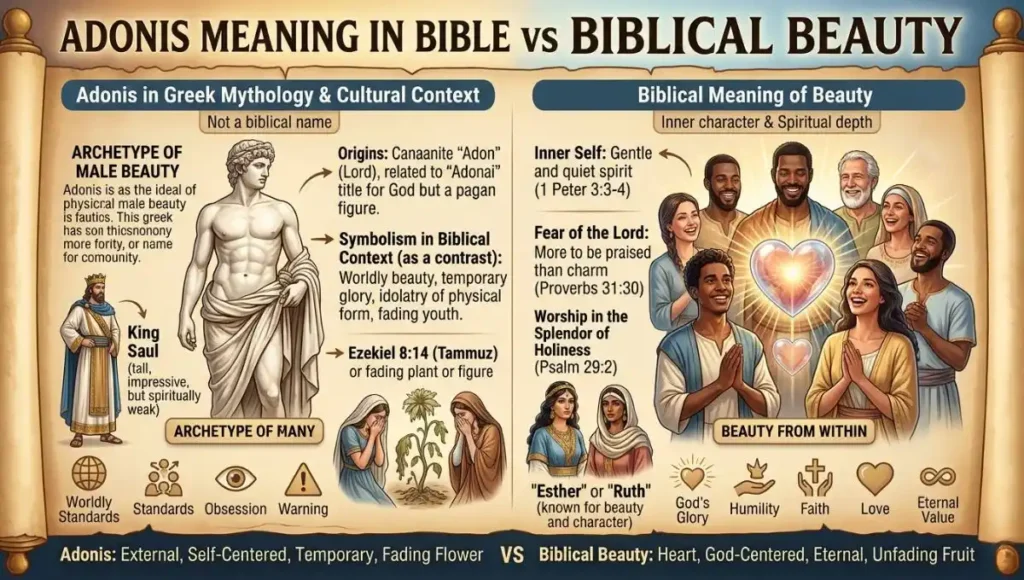
The Adonis meaning in Bible throws into sharp relief what Scripture actually teaches about beauty. Anyone who examines the Adonis meaning in Bible carefully quickly sees that the issue is not beauty itself but the worship of it.
The Bible does not condemn physical beauty. It acknowledges it Abraham’s wife Sarah was beautiful, Joseph was handsome, and David was described as having a fine appearance. But the Bible consistently refuses to make physical appearance the measure of a person’s worth or spiritual standing.
The Adonis biblical perspective on beauty differs from the Greek ideal in a fundamental way: Greek mythology worshipped beauty as divine. Scripture worships the divine who created beauty. That distinction changes everything.
“Your beauty should not come from outward adornment… Rather, it should be that of your inner self, the unfading beauty of a gentle and quiet spirit, which is of great worth in God’s sight.” (1 Peter 3:3–4)
This is the heart of the Adonis meaning in Bible for Christian living: not rejection of beauty, but reordering of what we consider beautiful and why.
Case Study: Pagan Beauty vs Biblical Character
The contrast embedded in the Adonis meaning in Bible finds a powerful illustration in the life of one of Israel’s most famous kings.
Biblical Example – King Saul
King Saul, the first king of Israel, was by all external measures an “Adonis” figure. He was tall, handsome, and physically impressive everything the people wanted in a king.
“There was not a man among the people of Israel more handsome than he. From his shoulders upward he was taller than any of the people.” (1 Samuel 9:2)
Yet Saul’s story ended in tragedy. His disobedience to God, pride, and spiritual instability disqualified him from the throne. God rejected him and chose David instead not because David was more handsome, but because God looks at the heart.
This narrative embodies the Adonis meaning in Bible at its most practical: outer glory without inner obedience is hollow. The Adonis ideal celebrates what fades. Biblical character cultivates what endures.
Anyone studying the Adonis meaning in Bible will find this Old Testament case study to be one of the clearest living illustrations of the contrast Scripture draws between appearance and godly character.
What Can Christians Learn from the Contrast Between Adonis and Christ?
The Adonis meaning in Bible reaches its deepest significance when compared not to a human king, but to Jesus Christ.
Adonis was a myth of a beautiful youth who died and returned. Jesus Christ is the Son of God who actually died and literally rose from the dead. The contrast is not merely symbolic it is historic and salvific. Every Christian who explores the Adonis meaning in Bible eventually arrives at this ultimate contrast.
Isaiah 53:2 describes Christ without idealized physical beauty: “He had no beauty or majesty to attract us to him, nothing in his appearance that we should desire him.” The Savior of the world did not look like an Adonis. And yet He accomplished what no mythological god ever could real redemption, real resurrection, and real relationship with God.
The Adonis meaning in Bible for Christians ultimately points to this: worldly standards of beauty and admiration are not the currency of the Kingdom of God. Humility, sacrifice, obedience, and love are.
Read Also: Holly Meaning in Bible: Spiritual, Cultural, and Symbolic Insights 2026
Spiritual Angle: Biblical Lessons from Adonis
The Adonis meaning in Bible offers several timeless spiritual lessons for believers navigating a culture saturated with image and appearance. Each lesson connects an ancient pagan practice to a modern spiritual challenge proving that studying the Adonis meaning in Bible is far from merely academic.
Lesson 1 – Identity is in Christ, not appearance. The Adonis myth ties worth to looks. Scripture ties worth to belonging to God. “See what great love the Father has lavished on us, that we should be called children of God!” (1 John 3:1)
Lesson 2 – Idol worship takes many forms. The Adonis spiritual meaning warns that anything we elevate above God including physical perfection, social image, or cultural ideals becomes an idol.
Lesson 3 – Temporary beauty is a poor foundation. The vegetation rites associated with Adonis illustrated how quickly beauty fades. Scripture agrees: “The grass withers and the flowers fall, but the word of our God endures forever.” (Isaiah 40:8)
Lesson 4 – True worship is exclusive. “Do not follow other gods, the gods of the peoples around you.” (Deuteronomy 6:14) The Adonis meaning in Bible underscores this command the temptation to blend cultural idols with genuine faith is ancient and ongoing.
Practical Advice: How Believers Should Respond to Adonis-Type Thinking
The Adonis meaning in Bible is not just historical it speaks directly to contemporary struggles. Here is how believers can practically apply what studying the Adonis meaning in Bible reveals. These applications transform theological knowledge into everyday Christian discipleship.
Renew your mind daily. Romans 12:2 calls believers not to be conformed to the pattern of this world. Adonis-type thinking valuing people by appearance, pursuing cultural ideals of attractiveness is exactly that pattern. The Adonis meaning in Bible gives this command specific, culturally-rooted urgency. Daily Scripture reading retrains the mind away from these patterns.
Guard what you admire. Social media feeds are modern temples to the Adonis ideal. Curating what you consume is a spiritual discipline. “Set your minds on things above, not on earthly things.” (Colossians 3:2) Returning to the Adonis meaning in Bible as a reference point helps believers identify and resist these cultural pressures.
Build identity in Scripture. The Adonis biblical meaning challenges us to answer the question: “Where do I find my worth?” Grounding that answer in Scripture rather than mirror or social approval is the practical application of the contrast between Adonis and biblical truth. Every time a believer faces appearance-based pressure, the Adonis meaning in Bible offers a clear, spiritually grounded counter-narrative.
Celebrate inner character. In your community, family, and conversations, intentionally praise character qualities faithfulness, kindness, wisdom over appearance. This actively counters Adonis-type culture. The Adonis meaning in Bible ultimately teaches that true worth is character-deep, not skin-deep, and that this principle has always been at the heart of biblical faith.
Biblical Principles for Choosing Meaningful Names

Many parents today search for the Adonis meaning in Bible specifically to decide whether it is an appropriate name for their child. This is a legitimate and important question.
The Bible places significant weight on names. In Hebrew culture, a name was not merely a label — it was a declaration of identity, calling, and character. Names like Abraham (“father of many”), Samuel (“heard by God”), and Isaiah (“the LORD saves”) carried theological meaning. The Adonis meaning in Bible research shows that this name was associated with paganism rather than these kinds of godly declarations.
When evaluating the Adonis meaning in Bible as a potential name for a child, consider the following biblical principles.
What does the name declare? Names rooted in Scripture or in godly virtues carry a blessing. Adonis, rooted in pagan mythology and idol worship, declares an association with beauty and desire rather than faith and character.
What legacy does it carry? The Adonis name meaning in history is connected to a false deity, seasonal worship rites, and pagan festivals. For a Christian family, this legacy is worth weighing carefully. The Adonis meaning in Bible research confirms that the name carries mythological and idolatrous associations that set it apart from Scripture-rooted names.
Grace and freedom in Christ. The New Testament does not legislate specific name choices. A believer named Adonis is no less saved or loved by God. But for families wishing to choose a name with positive biblical resonance, Scripture offers thousands of richer alternatives.
Modern Usage of the Name Adonis
Today, the name Adonis is used in many cultures as a first name and as a common metaphor for exceptional physical attractiveness. “He’s a total Adonis” is a phrase used to describe a strikingly handsome man.
In contemporary pop culture, the Adonis name meaning has largely been stripped of its pagan religious context. Most people using the name today are unaware of its mythological and biblical-adjacent history. This is precisely why understanding the Adonis meaning in Bible matters it provides cultural and spiritual literacy that most secular sources simply do not offer.
From a Christian view of Adonis, there is pastoral sensitivity required here. The name does not carry spiritual danger by itself in a modern context. However, understanding the Adonis meaning in Bible equips believers to engage thoughtfully with questions of identity, culture, and naming rather than simply following trends.
The Adonis meaning in Christianity ultimately encourages believers to be culturally informed and spiritually discerning, holding every name and ideal up to the light of Scripture.
Common Misunderstandings About Adonis Meaning in Bible
Several misconceptions circulate when people research the Adonis meaning in Bible. Addressing them directly builds clarity.
Misconception 1: “Adonis is a biblical name.” It is not. Adonis does not appear as a person in Scripture. Its linguistic root (adon, meaning lord) appears in Hebrew, but Adonis as a figure is entirely Greek and Phoenician mythology.
Misconception 2: “Adonis and Adonai are the same thing.” They share a Semitic root but are theologically opposite. Adonai is a holy name reserved exclusively for God, while Adonis is a pagan deity figure. Conflating them is a significant theological error.
Misconception 3: “The Bible endorses Adonis because it appears in Isaiah.” The marginal reference in Isaiah 17:10 is descriptive, not endorsing. It documents the idolatrous practices God was judging, not approving.
Misconception 4: “The Adonis myth predicts Christ’s resurrection.” Some scholars draw typological parallels, but the differences are more significant than the similarities. The Adonis myth is cyclical, nature-based, and fictional. The resurrection of Christ is a historical event, singular, and salvific.
Understanding the Adonis meaning in Bible accurately protects believers from these theological pitfalls. Teachers, pastors, and Bible students who clearly communicate the Adonis meaning in Bible help their communities develop a more grounded, Scripturally-informed worldview.
Frequently Asked Questions
Below are the most common questions readers ask when researching the Adonis meaning in Bible. Each answer reflects both historical research and biblical truth.
Who was Adonis in mythology?
Adonis was a figure from Greek and Phoenician mythology a strikingly handsome young man beloved by the goddess Aphrodite, whose death and revival became the basis of annual pagan worship festivals celebrating the cycle of vegetation.
Is Adonis a god in the Bible?
Adonis is not named as a god in the main text of the Bible, but his equivalent Tammuz appears in Ezekiel 8:14 as a pagan deity whose worship God condemned in the strongest terms.
What is the spiritual meaning of Adonis?
The Adonis spiritual meaning in a biblical context is a warning: beauty, desire, and physical perfection make poor substitutes for genuine faith, inner character, and obedience to God.
Is Adonis related to Adonai?
Linguistically, both derive from the Semitic root adon (“lord”), but theologically they are opposites Adonai is the holy name of Israel’s God, while Adonis is a pagan mythological figure.
Why is Adonis associated with beauty?
In Greek and Phoenician mythology, Adonis personified youthful beauty and was connected to the desire of the goddess Aphrodite, making him the cultural symbol of physical perfection.
What can Christians learn from Adonis?
Christians can learn the timeless biblical lesson that outward appearance is temporary, identity is found in Christ not culture and idol worship takes many subtle forms in every generation.
Is the name Adonis suitable for Christians?
The name is not biblically forbidden, but its mythological and pagan religious roots are worth understanding. Families seeking names with positive spiritual resonance may prefer Scripture-rooted alternatives.
What does the Bible teach about beauty?
The Bible teaches that physical beauty is not morally significant on its own. True beauty, according to Scripture, is inner character a gentle spirit, faithfulness, and the fear of the LORD (Proverbs 31:30, 1 Peter 3:3–4).
What is the difference between Adonis and Adonai?
Adonis is a Greek-Phoenician mythological deity of beauty; Adonai is the Hebrew name for the living God of Israel. They share a linguistic root but are theologically worlds apart.
Is Adonis connected to idol worship?
Yes. The Adonis meaning in Bible is inseparably linked to the pagan worship practices the Bible explicitly condemns, including the Tammuz festivals described in Ezekiel and the idolatrous “plantings” referenced in Isaiah 17:10.
Conclusion
The Adonis meaning in Bible is rich, layered, and spiritually significant even though Adonis himself is not a biblical character. It is a name that originated in pagan mythology, carried by a figure whose worship the Bible directly opposed, yet whose linguistic root is surprisingly close to the Hebrew word for “lord.” Grasping the Adonis meaning in Bible fully requires both historical scholarship and theological discernment.
Understanding the Adonis meaning in Bible teaches believers several things. It shows that Scripture is deeply embedded in real history a history filled with competing religions, false gods, and cultural temptations that mirror our own.
It shows that God’s people have always been called to a different standard: inner character over outer beauty, eternal values over temporary admiration, and true worship over cultural idol-following. Anyone who takes the time to study the Adonis meaning in Bible emerges with a sharper, more biblically-grounded perspective on identity, beauty, and worship.
The contrast between Adonis and Adonai between a mythological ideal of beauty and the holy, living God is not just an academic exercise. It is a call to examine what we actually worship, what we genuinely value, and where we truly place our identity.
“Do not conform to the pattern of this world, but be transformed by the renewing of your mind.” (Romans 12:2)
In every generation, including our own, the Adonis meaning in Bible challenges believers to choose the eternal over the fleeting, the sacred over the sensational, and the God who made beauty over any cultural idol that mirrors it.

Zohaib Israr is a content writer at [prayersmsg.com], specializing in Messages and Prayers. With 5 years of experience, he creates meaningful, engaging, and easy-to-read content that connects with readers.