If you’re expecting a baby boy, or you simply came across the name somewhere and got curious, there’s a good chance you’ve typed “Carter name meaning in the Bible” into a search bar. It’s a fair question to ask. Carter sounds strong, grounded, and a little old-fashioned, which makes a lot of people assume it must have scripture behind it.
The short answer is that Carter isn’t a biblical name in the traditional sense. It doesn’t appear in any verse, and no prophet, disciple, or tribe carried this name in scripture. But that doesn’t mean the name lacks meaning. Over time, people have built a rich layer of symbolism around it, one that connects surprisingly well to biblical values like service, humility, and strength.
This guide takes a deep, detailed look at the Carter name meaning in the Bible, unpacking exactly what Carter name meaning in the Bible really points to, alongside its real historical origin, its supposed Hebrew connection, the personality traits associated with it, and the verses people commonly link to it. By the end, you’ll have a complete picture of where the name comes from and why so many Christian families still choose it.
Definition of the Carter Name
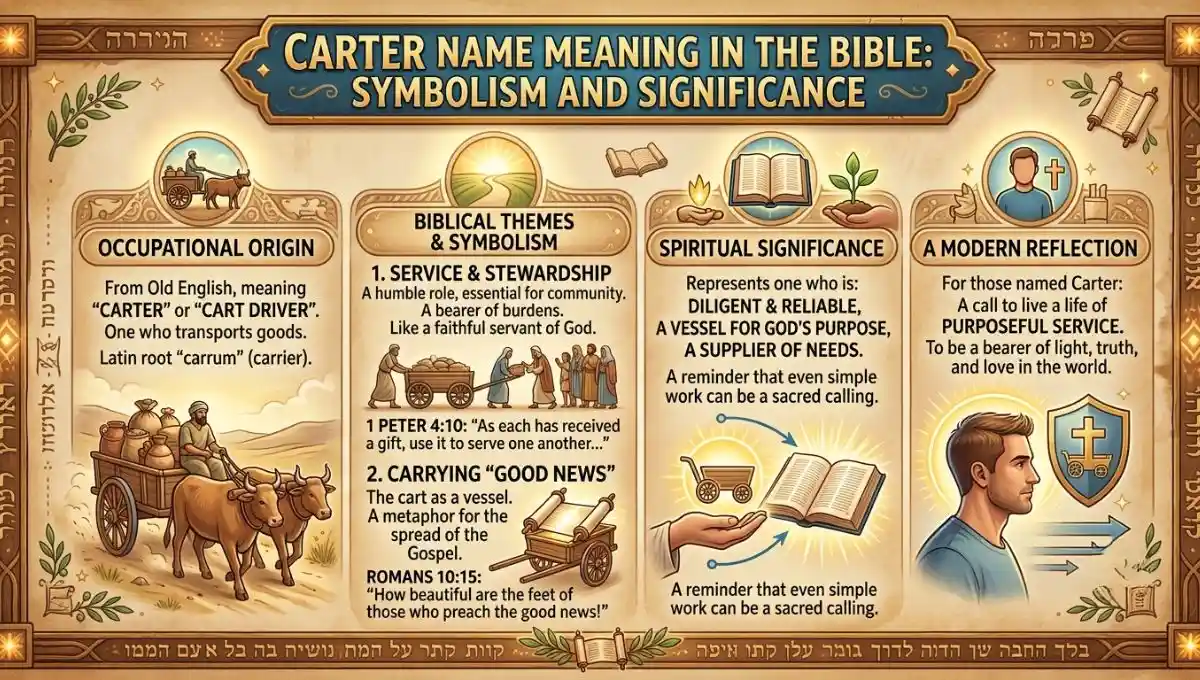
At its core, Carter is an occupational name. It described someone whose job was to drive a cart and haul goods from one place to another. It comes from the Middle English word “cartere” or the Old French “caretier,” referring to a person who transported goods by cart or wagon.
So when people search for the Carter name meaning, the literal definition is simple: “one who carts” or “one who transports goods.” It’s a practical label, not a poetic one. Centuries ago, naming someone after their trade was extremely common. If a man earned his living moving goods by cart, his neighbors and town records would simply call him “the carter.” Eventually that occupational tag became permanent, passed from father to son, until it stopped describing a job and started identifying a family.
This practical background is exactly why understanding the meaning of the name Carter requires looking at history first and spiritual interpretation second. The name didn’t start with any religious intention attached to it. Its depth came later, built by the people who carried it and the meaning they chose to find in it.
The Origin of the Carter Name: Where Does It Come From?
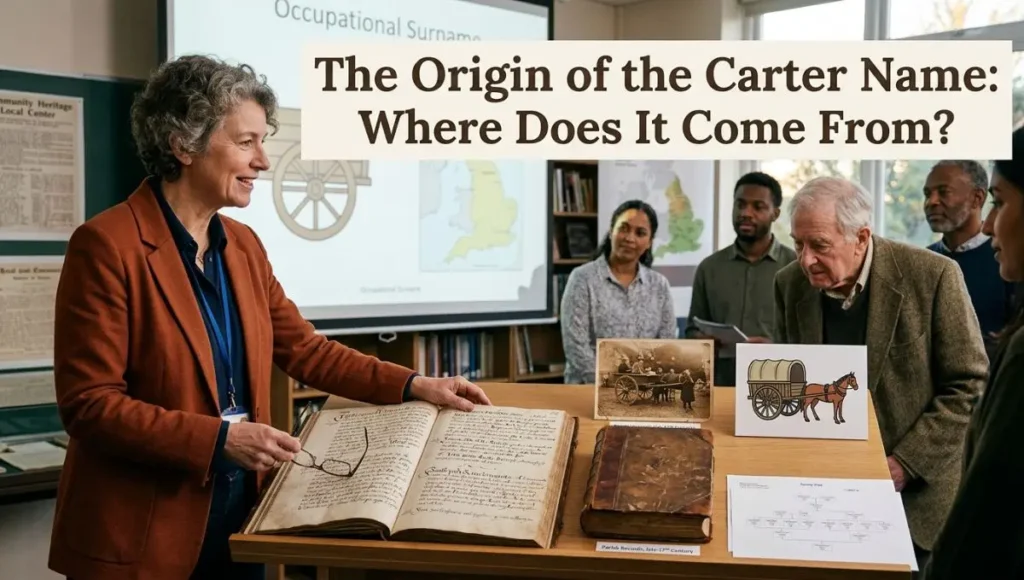
The Carter name origin traces back to medieval England, not the ancient Near East or biblical lands. Carter is an English surname and given name that means “one who uses a cart,” derived from Anglo-Norman careter or caretier. The earliest recorded use of the surname dates back to 1192–1193, when a Norman knight named Rannulf le Caretier appears in the Pipe Rolls of Huntingdonshire, during the reign of King Richard I, also known as Richard the Lionheart.
Less than a century later, the Hundred Rolls of 1273, a detailed census of England and Wales, recorded several early bearers of the name across Oxfordshire, Cambridgeshire, Norfolk, and Huntingdonshire. By the late 14th century, the Poll Tax records of Yorkshire list “Richardus Carter” as another bearer of the Anglicized form of the name.
Back then, people were typically identified by their trade rather than a fixed family surname. A man named John who drove a cart for a living might be known locally as “John the Carter.” Over generations, the occupational title attached to his name stuck, eventually dropping the “the” and becoming a hereditary surname passed down to his children, regardless of whether they continued the same trade. This naming pattern wasn’t unique to Carter — it gave rise to other familiar English surnames like Smith, Baker, Miller, and Cooper, all rooted in medieval professions.
This is the standard explanation behind the English surname meaning Carter — it’s an occupational surname that eventually became a given name, not a religious or scriptural one. Today, Carter ranks as the 44th most common surname in the United States and the 56th most common in England, and in recent decades it has become an increasingly popular first name for boys across the United States, Canada, and Australia.
It’s worth noting that the surname spread well beyond England too. It has documented roots in Irish and Scottish naming traditions as well, sometimes tied to the Gaelic word for a traveler. Regardless of which exact regional thread you trace, all paths point back to the same practical idea: someone who worked hard, moved goods, and kept communities connected through honest labor.
Is the Name Carter Mentioned in the Bible?
This is the question most people actually want answered. Is Carter mentioned in the Bible directly? No — you won’t find “Carter” listed as a person, tribe, city, or place anywhere in the Old or New Testament.
That’s an important distinction to make when discussing Carter biblical significance. Names like Matthew, Isaiah, Daniel, or Hannah appear word-for-word in scripture, tied to specific people and stories. Carter does not share that history. Its connection to the Bible is symbolic and interpretive rather than literal, built around the themes of carrying, serving, and transporting that the name’s occupational root naturally suggests.
So, is Carter a biblical name? Not historically, and not linguistically. But many Christian parents still consider it a meaningful, faith-aligned choice because of what the name represents rather than where it literally appears in the text. This is actually a common pattern with modern baby names. Names like Mason, Hunter, and Carter all share occupational roots, and parents often look past their literal job-title origin to find a deeper personal or spiritual meaning that resonates with their own values.
If you’re specifically searching for “does the Bible mention the name Carter,” the honest answer remains no. What the Bible does offer, though, is plenty of language around carrying, serving, and bearing weight for others, which is exactly the imagery that gives the name its modern spiritual flavor.
Carter Name Meaning in Hebrew: Insights and Interpretation
People often search for the Carter name meaning in Hebrew expecting to find a direct translation, similar to how Daniel means “God is my judge,” or Hannah means “favor,” or Gabriel means “God is my strength.” But Carter has no Hebrew root at all. Its history is entirely English and Anglo-Norman, with no connection to ancient Hebrew language or scripture.
That said, some people still look for Hebrew concepts that echo a similar spirit, even without a literal translation. The closest comparison drawn is the Hebrew idea of an “eved,” meaning a servant, or one devoted to a greater purpose. It’s not a translation in any technical sense, just a thematic parallel some people draw when exploring the spiritual meaning of Carter.
If you’re specifically looking for Hebrew-origin names with similar undertones of service or purpose, names like Natan (meaning giver), Avodah (meaning work or service), or Shaliach (meaning messenger or agent) carry that same general energy, even though none of them are linguistically related to Carter in any way.
So while the Carter name meaning in Hebrew doesn’t technically exist as a literal definition, the name still manages to fit comfortably alongside Hebrew concepts of service and devotion when viewed through a symbolic lens rather than a linguistic one.
Spiritual Meaning of the Carter Name: What Does It Represent?
Even without ancient scriptural roots, the spiritual meaning of Carter has grown organically through how people interpret its occupational history. A carter’s job was to carry, deliver, and transport, often traveling long distances while caring for his animals, tools, and the goods entrusted to him. Many find a parable in that simple, hardworking role.
In a Christian context, “carrying” shows up again and again as a metaphor for faith and discipleship. Carrying burdens, carrying the cross, carrying the gospel to others, carrying hope through difficult seasons — all of it lines up neatly with what a literal carter did for a living, just translated into spiritual terms.
So when people ask about Carter meaning in Christianity, the answer usually centers on this symbolism: a person built for service, responsibility, and steady, dependable work — qualities that scripture consistently praises throughout both the Old and New Testaments. Whether or not a family intends it this way, the Carter name carries an undertone of someone who shows up, does the work, and helps move things, and people, forward.
This is also where the idea of biblical servant leadership often gets attached to the name. Servant leadership, a theme found throughout the gospels, describes leading not through power or status, but through humble, consistent service to others. A carter, historically, was never a person of high status. He was simply someone society depended on to keep things moving, much like the quiet, steady kind of leadership scripture often praises.
Biblical Qualities and Personality Traits Associated with the Name Carter
Names often get linked to personality traits, and Carter is no exception. Based on its occupational and symbolic background, here are the traits most commonly associated with the name:
- Diligence — a carter’s work demanded consistency and reliability, day after day, regardless of weather or distance.
- Strength — both physically and emotionally, to manage the demands of constant labor, travel, and unpredictable roads.
- Humility — it was a working-class trade, not a position of status, wealth, or pride.
- Service — the entire purpose of the job was helping others by moving what they needed from one place to another.
- Stewardship — caring for tools, animals, and goods that ultimately belonged to someone else.
- Perseverance — long journeys, difficult terrain, and repetitive work required a steady, unshaken resolve.
- Integrity — trade depended on trust, since carters were responsible for goods that weren’t their own.
These Carter name traits aren’t drawn from any single Bible verse directly, but they align comfortably with biblical virtues like service, humility, and faithful stewardship that appear throughout scripture, from Proverbs’ praise of diligent hands to the New Testament’s repeated emphasis on humble service.
People who carry this name, or parents considering it for their child, often appreciate that it doesn’t lean on flash or status. Instead, it leans on dependability, which many would argue is one of the most underrated but biblically respected character traits a person can have.
Read Also: 40+ Powerful Closing Prayer for Bible Study with Scriptural
Bible Verses That Reflect the Meaning of the Name Carter
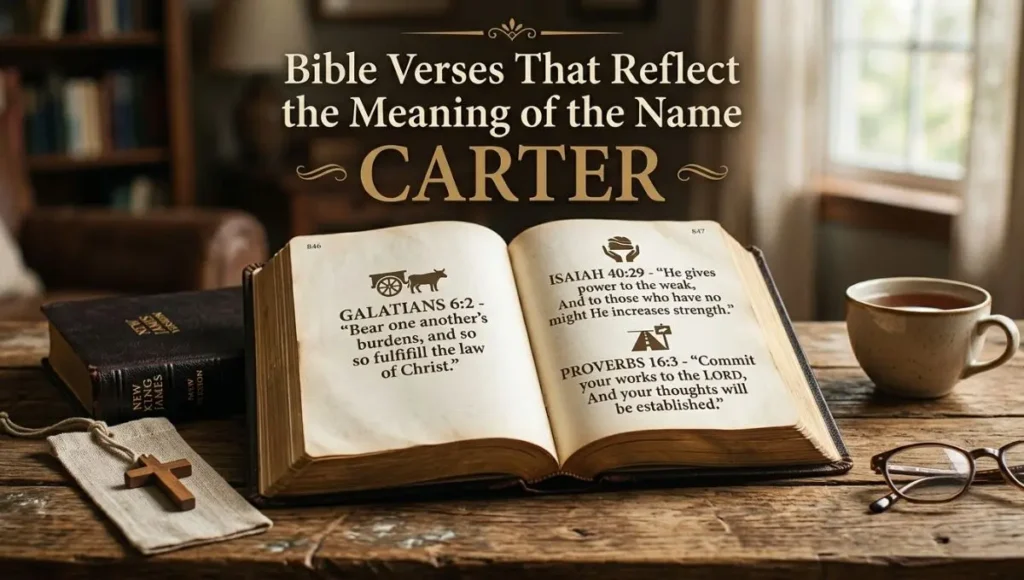
While there’s no verse that mentions Carter directly, several passages echo the themes people connect to the name, particularly the ideas of carrying burdens and serving others faithfully.
Galatians speaks directly to this idea of shared responsibility: “Carry each other’s burdens, and in this way you will fulfill the law of Christ” (Galatians 6:2). It’s often the first verse people cite when discussing the Carter biblical meaning, since it captures the exact spirit of carrying something for someone else’s benefit.
Isaiah offers another powerful angle, describing God himself as one who carries his people: “Even to your old age and gray hairs I am he, I am he who will sustain you. I have made you and I will carry you” (Isaiah 46:4). This passage reframes “carrying” not as a burden, but as an act of love and protection, which adds a gentler dimension to the name’s symbolism.
Colossians reinforces a similar theme of humble, faithful labor, encouraging believers to work at everything with their whole heart, as if working for the Lord rather than for people (Colossians 3:23). This verse pairs naturally with the diligence and steady work ethic historically tied to the carter’s trade.
Matthew also touches on the theme of carrying weight for others, particularly through the image of taking up one’s cross and following a path of service rather than self-interest. Together, these passages from Galatians, Isaiah, Colossians, and Matthew form the backbone of why so many people connect the Carter name meaning in the Bible to themes of service, support, and quiet strength, even without a direct scriptural reference to the name itself.
Popular Nicknames for the Name Carter

Carter is short and strong on its own, but it still picks up a few casual nicknames depending on family preference and personality:
- Cart
- CJ (often used when paired with a middle name)
- Carty
- Ace (a stylistic nickname some families choose, unrelated to the name’s literal meaning)
- Wheels or Wagon (playful nicknames that nod back to the name’s original occupational meaning)
Most parents simply keep it as Carter, since the full name already feels complete and doesn’t necessarily need shortening. Still, these nicknames show up casually among friends, classmates, or within families who enjoy a more personal, informal touch.
FAQs (Carter Name Meaning in the Bible)
What does Carter mean in the Bible?
Carter doesn’t appear in the Bible at all. Its meaning is symbolic, tied to the idea of carrying burdens and serving others rather than a direct scriptural reference.
Is Carter a biblical name?
No, Carter is an English occupational surname with roots in medieval England, not a name that originates from Hebrew or Greek scripture.
Is Carter mentioned in the Bible?
No. There’s no person, place, tribe, or reference named Carter anywhere in the Old or New Testament.
What is the spiritual meaning of Carter?
Spiritually, Carter is often associated with service, responsibility, and the act of carrying others’ burdens, themes that closely echo biblical values.
What does Carter mean in Hebrew?
Carter has no Hebrew origin or direct translation; any Hebrew comparisons people draw are thematic, not literal or linguistic.
Is Carter a Christian name?
It isn’t biblically rooted, but many Christian families still choose it for its symbolism of humble service, strength, and dependability.
What personality traits are associated with Carter?
Diligence, strength, humility, perseverance, and a service-oriented spirit are the traits most commonly linked to the name.
What Bible verse matches the name Carter?
Galatians 6:2, which speaks about carrying one another’s burdens, is the verse most often paired with the name’s meaning.
Where does the name Carter come from?
Carter comes from medieval England, originating as an occupational surname for someone who transported goods by cart or wagon.
Is Carter a good biblical baby name?
It isn’t historically biblical, but its underlying themes of service, humility, and strength make it an appealing, meaningful choice for many Christian parents.
Conclusion (Carter Name Meaning in the Bible)
Searching for the Carter name meaning in the Bible usually leads to one honest, well-supported conclusion: Carter isn’t a biblical name by origin, and it’s never directly mentioned anywhere in scripture. Its true roots lie in medieval England, where it began as a practical, occupational surname for someone who transported goods by cart, not in ancient Hebrew tradition or biblical genealogy.
Still, the name has earned its own kind of spiritual weight over time. Through the imagery of carrying, serving, and supporting others, the Carter name meaning in the Bible has come to symbolize values that scripture holds in extremely high regard, including diligence, humility, stewardship, and faithful service. Verses from Galatians, Isaiah, and Colossians all reflect this same spirit, even without naming Carter directly.
For many parents today, that symbolism is more than enough. A name doesn’t need to appear in scripture word-for-word to carry meaning rooted in faith. When you look at the full picture, from its English working-class origins to the spiritual themes people have layered onto it over generations, the Carter name meaning in the Bible becomes less about a missing verse and more about the quiet, steady character the name has come to represent.

Zohaib Israr is a content writer at [prayersmsg.com], specializing in Messages and Prayers. With 5 years of experience, he creates meaningful, engaging, and easy-to-read content that connects with readers.